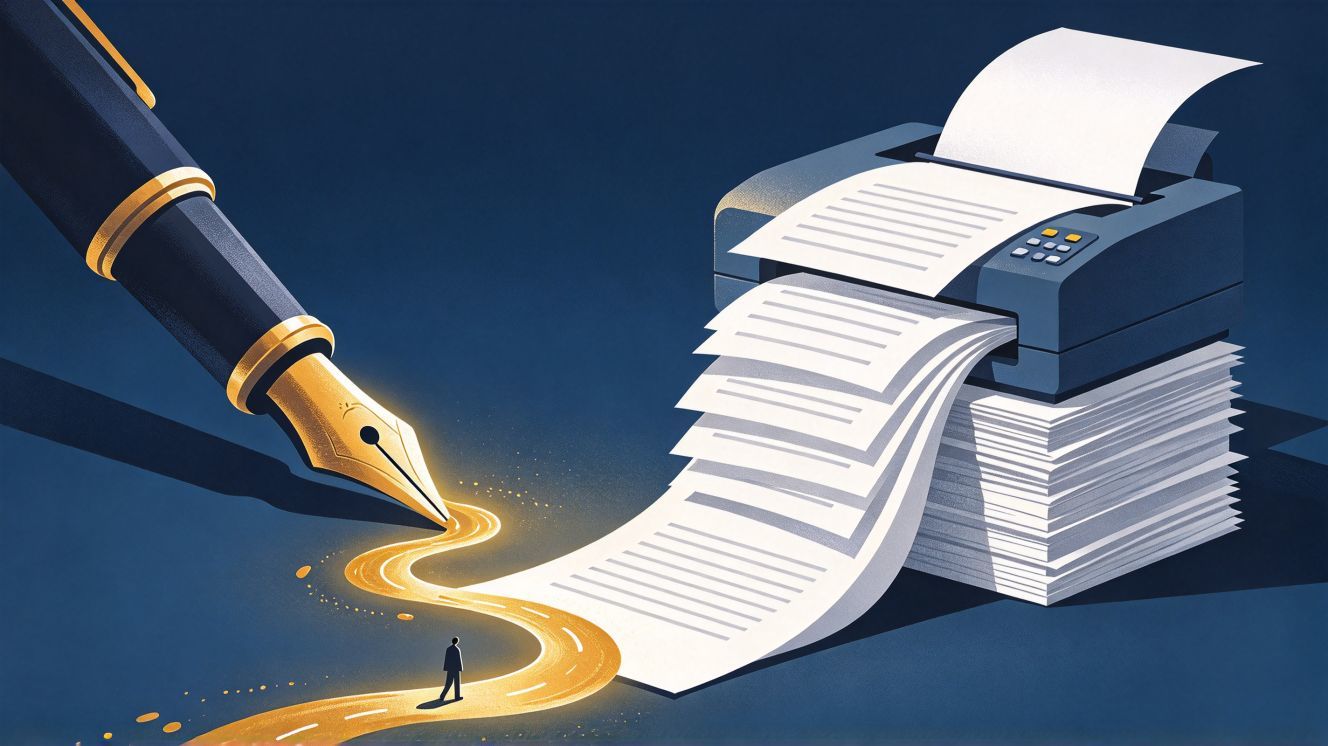
They Said AI Could Write Everything—So Why Are Human Blogs Thriving?
In November 2024, AI-generated articles on the English-speaking web outnumbered human-written ones for the first time1. By May 2025, a Graphite sample of 65,000 English web articles put the AI share at 52%. Macquarie Dictionary went and picked “AI slop” as its 2025 word of the year; Chinese netizens have an even more vivid name for it: “AI 味” (AI flavor)2.
By that logic, if AI can write for you, why would anyone bother writing themselves?
Reality, though, runs the other way. Human-written independent blogs are warming up again — the “Blogging Renaissance,” as people call it3.
Why? When everything reeks of AI slop, things with a human smell become the scarce commodity. The more AI can write, the more valuable what you write becomes — that, roughly, is the reason for the comeback.
But “should you write” and “where you write” are two different questions: on a platform account, or somewhere you actually call the shots? That has to start with what’s wrong with platforms.
Rented Space: You Don’t Get the Final Say
Deleted on a Whim, With No One to Argue With
In March 2026, the messaging platform updated its operating rules to explicitly ban “non-human automated creation” (clause 3.27)4. Collateral damage followed fast: one author’s article was typed out word by word by hand, but merely using a third-party formatting tool and consistent paragraph styling got it flagged as AI creation and deleted4. An operator who manually uploaded images was also misjudged as “non-human automated creation”; after appealing, they only got a one-liner saying “violation confirmed” — which sentence violated what, what the evidence was, no explanation at all4.
The appeal process is worse. When a violation is triggered by backend review or user reports, the article is basically deleted with no path to appeal; in the one scenario where an appeal channel exists, the author can’t even see the complaint — which sentence was deleted, whether the evidence holds up, all unknown4.
Over on the Q&A platform, 2026 brought several rounds of AIGC-governance announcements folding, throttling, and silencing low-quality AI content. The logic isn’t “did you use AI,” but “did the content trip the detection model” — repetitive sentence patterns, flat vocabulary distribution, emotionally flat writing can all get you flagged. Some creators appealed repeatedly without success and “eventually gave up.”
What these cases share: you have no final say over what you wrote. The platform’s algorithm only looks at surface features — layout, sentence patterns, posting frequency. What your article actually says, it doesn’t care. That’s what’s most dangerous about a “rented” relationship — you think you’re writing on your own account, when really you’re just arranging furniture in a house that can be taken back at any moment.
The Platform’s Users Never See You—Let Alone Become Your Readers
In 2026, the average reach rate for an Instagram post fell to 3.5%–7.6%, roughly half of the 10%–15% of 2020; Facebook page organic reach hovers around 5%, worse for big pages5. Ten years ago, a post might be seen by 16% of your followers; now, reliably reaching 1 in 10 is already decent.
This isn’t a “temporary fluctuation.” It’s deliberate: the algorithm reserves placement for content that monetizes directly — no money, no exposure. The goal is ad revenue. Falling organic reach and growing ad revenue are two sides of the same coin.
I’ve thought about email newsletters too — open rates typically run 30%–40%, reaching people who actually subscribed6. The gap is several-fold, sometimes dozens of times.
But low reach isn’t even the core issue. The platform’s users are not your fans; they’re the platform’s users. If the algorithm doesn’t show them your posts, they’ll never become your readers. The followers you “accumulate” on a platform are, at bottom, rented spectators. The algorithm decides who sees you today, and it won’t notify you before it changes the rules.
Now AI Makes the Collateral Damage Worse
Platforms use AI to catch AI content, but the detection itself is shaky. Surfer, the detector Graphite used, reported a 4.2% false-positive rate on human articles in Graphite’s own tests1; in Chinese, Southern Metropolis Daily tested 10 mainstream AI detectors in 2025 and got classic authors flagged as AI7:
| Tested work | Detector | Verdict |
|---|---|---|
| Lao She, “Lin Hai” (林海) | Maomaochong (茅茅虫) | 99.9% AI-generated |
| Lao She, “Lin Hai” (林海, 1,300+ chars) | Wanfang (万方) | 35.6% false-positive rate |
| Zhu Ziqing, “Moonlight over the Lotus Pond” (荷塘月色) | A mainstream tool | 62.88% flagged as AI |
Creators are squeezed from both sides: use AI as an assist and you’re “non-human creation”; write everything by hand and you might still be flagged for being too “standardized.” Platforms govern AI with algorithms, but the algorithms are themselves AI. Real humans pay the price for the false positives.
AI Can Write Anything—Except You
It Can Give Answers, but Thinking Is on You
A large language model’s logic is “predict the probability of the next token,” producing the statistically most likely word sequence rather than the most insightful expression8. It has no self-awareness, none of your experiences, bears no consequence for choices, and doesn’t care whether what it writes is right.
Writing isn’t “pouring out what you already think clearly.” Writing is the thinking itself. You sit down to make a point, and at the third paragraph the logic breaks; you go back and re-examine your premises — that process never happens when AI drafts for you. If you can’t write it clearly, you haven’t thought it through. Ruan Yifeng once put it plainly: “A blog is, first of all, a knowledge-management tool, and only secondarily a communication tool. I only write about things I haven’t yet fully mastered.”9 He’s been at it since 2003 — more than 1,500 posts, a complete thread of over two decades of thinking.
There’s a Hacker News thread about this too. One blogger wrote: “I write my blog mainly to improve my writing ability, which has always been weak for me. This itself is valuable. I don’t care if nobody reads it.” Someone replied: “Even if nobody reads my blog, the act of writing forces you to actively think about the ideas and confront the contradictions you may have.”10
Write on, and your sense of self gets clearer. AI can’t do that part, because AI has no “self” to clarify. Calculators didn’t make people give up math, and AI shouldn’t make people give up writing.
Content Can Be Mass-Produced; Experience Can’t Be Copied
One deep article beats ten business cards, because an article is verifiable.
AI can summarize a thousand generic takes on “how to optimize your database,” but it doesn’t have the raw material of “how we cut query latency from 2 seconds to 50 milliseconds” — if you haven’t stepped on that rake, you have no such experience to write about. The pain points you actually hit, the concrete numbers, the hesitation when making a choice, and the reflection afterward — that’s a human’s unique asset.
One Person, One Company: Your Blog Is Your Credit Asset
In 2026, the “one person company” (OPC) is moving from concept to large-scale practice. According to the Zhongguancun Talent Association’s “China OPC Development Trend Report (2025–2030),” as of June 2025 the stock of single-person limited-liability companies nationwide had surpassed 16 million, 27.4% of all enterprises; in the first half of 2025 alone, 2.86 million were newly registered, up 47% year over year, 23.8% of all new registrations11. In Hangzhou, Shenzhen, Beijing, and Shanghai, OPCs account for over 50% of newly established firms.
Among OPC founders, people without a technical background now make up the majority — operations, growth, design, and content people are pouring in12. AI has slashed the capital barrier: one person, one computer, a set of AI tools can run what used to take a team. When one person can pull that off alone, how does the outside world judge whether you’re trustworthy? A resume? Self-introduction? Neither beats a sustained public record.
Your blog is the verifiable credit asset of your strategic judgment, technical ability, and product taste. A potential client or partner opens your blog, sees two years of steady technical analysis, product thinking, and industry judgment — trust is built in that moment. No face-to-face, no sales pitch.
AI has compressed product development cycles so much that “I can build the product” is no longer a differentiator. “I can clearly explain why I built it, what problem it solves, and what my reasoning is” — that is. A blog is exactly the vehicle for that kind of explanation.
Canned-Flavor Content Is Everywhere; Human Writing Is What’s Priceless
“AI flavor” isn’t some mystical feeling; it has text features you can analyze. Chinese Social Sciences Today breaks AI-written text down into three layers8:
| Layer | What AI-written text looks like |
|---|---|
| Vocabulary | Prefers high-frequency, neutral “safe words”; avoids dialect, slang, and personal color |
| Sentence | Sentence length too uniform; lacks the rhythmic tension of human language |
| Structure | Highly templated; leans on “firstly, secondly, in short” as decorative pseudo-logic |
Two studies — one in PNAS, one in Computers in Human Behavior: Artificial Humans — point the same way: AI-generated stories are highly repetitive, contribute less to creative diversity than human writing, and the gap grows the more you generate1314. Put simply: the more AI writing you read, the more it all feels the same.
Ann Handley nailed it in her 2025 analysis: “AI makes information abundant and cheap. Humans create what’s scarce—and therefore valuable.”15 What’s truly scarce: meaning, trust, attention.
There’s also a practical bonus: GEO (generative engine optimization) — making sure AI doesn’t misrepresent your content when it “cites” you. The priorities include clear heading hierarchies, conclusions up front, and bullet-style key points16.
But Ann Handley found something else too: “the more you outsource writing to it, the worse the output gets.”15 AI is good at grunt work: transcription, formatting, first drafts, organizing thoughts. It’s not good at being “the storyteller” — injecting judgment, deciding what to say, choosing the voice. AI can expand an idea into 800 words, but the judgment that only you can produce — grounded in real experience — it can’t give you that.
It Won’t Steal Your Job—It Just Saves You Grunt Work
Work AI into your process and let it carry the repetitive, tedious, time-consuming parts: research and competitor analysis when choosing topics, expanding ideas and structuring drafts, checking grammar and polishing layout at review time. But the core decisions — what the article is really saying, what voice to use, what to keep — stay with you.
There’s a practical workflow:
AI manages the input and organization of knowledge; you own the output and expression.
So, when everyone is generating content with AI, the marginal value of human writing is going up, not down.
A Blog Costs Almost Nothing
Static blog hosting in 2026 has matured into a budget setup. To build a blog you only deal with three things: tools, platform, and domain — the first two are free, the domain costs money.
The Tools Are All Free
Tools are software running on your own machine, independent of any platform. A static site generator turns Markdown into HTML; a deployment tool pushes the files live.
Pick a generator by habit: Hugo if you want speed (millisecond builds, a single binary); Astro if you want the new hotness (zero JS by default, can mix React/Vue/Svelte components); Hexo runs on Node.js with the most Chinese-language docs; pair Jekyll with GitHub Pages for native support, just slower builds.
Deployment is even easier: git push to the repo, and GitHub Actions or the platform’s Git integration builds and ships it; Cloudflare’s official CLI (Wrangler) even gives you local previews.
All of this is free: the generators above are open source, and GitHub Actions is unlimited for public repos. All you need is a text editor and a command line.17
Every Platform Has a Free Tier
Platforms are hosting services — CDN, SSL, access control are their job. Cloudflare, Vercel, Netlify, GitHub Pages, EdgeOne Makers: the mainstream options all have free tiers generous enough for a personal blog — bandwidth, build minutes, HTTPS — the basics cost nothing18.
The Only Thing That Costs Money Is the Domain
A domain runs about 10–15 USD a year — under a dollar a month.
If You Can Move It, You’re Not Locked In
The tools and platforms, at the end of the day, are someone else’s — rented, just like platform accounts. The difference is whether you can switch: the tools are open source, switch anytime; the static files are in your own hands, so you can move the whole thing whenever you want. Because it’s movable and replaceable, you’re not locked in.
One honest note: free tiers change whenever they feel like it, and subdomains like *.pages.dev are rented too. So no matter which one you pick, keep that habit of backing up your Markdown and staying portable — your domain and your source files are what you actually own.
AI Makes Building a Blog Easier
The barriers to blogging have always been half money, half technical skill.
Before, escaping the sea of identical themes meant writing code yourself or paying someone to custom-build it — developing from scratch cost a fortune. AI has flattened that road: some people had AI write PHP to replace Typecho, some built with Next.js + Fumadocs, others assembled FastAPI + Jinja2 + MDUIv2 and generated a full color scheme from a color they liked19.
The common thread is blunt: you no longer write every line yourself — AI turns “what you want” into “a working program.” The bar drops from “can write code” to “can say clearly what you want.”
What’s left to care about is worth caring about: what your blog looks like, what goes in it, why it’s designed that way. Posts like “why I chose Next.js + Fumadocs over Hexo” are about tech choices on the surface; underneath they’re taste and judgment.
To Close
The last thing to worry about with a blog is nobody reading it. One reader who actually resonates beats ten thousand aimless page views. A problem you stepped on three years ago might be what someone is searching for at midnight right now — and they email you after reading. That kind of connection isn’t measured in traffic. So don’t chase views; write what you have unique experience in, write what you searched for and couldn’t find an answer to, and write things you’d want to reread in three years. The people who actually need your articles will find them.
As for payoff, the direct financial returns are genuinely unremarkable, but there’s something more solid. A sustained public record beats a resume — people have gotten remote-job offers through their blogs. The professional trust a deep article builds can turn into consulting and collaboration. Content also compounds: a tutorial written in 2023 might still be bringing search traffic and readers in 2026.
In an age where AI can duplicate content infinitely, still writing under your own domain, in your own voice, what you truly believe — that alone, to me, is worth it.
An independent blog isn’t about how many people see it. It’s about having a place to honestly record your thinking, test your judgments, and quietly wait for the people who genuinely need you.
Ruan Yifeng said it plainly back in 200620:
“One of the biggest benefits of long-term blogging is that, as you write on, your sense of self becomes clearer and clearer.”
Twenty years on, I believe that sentence.
Start writing your first post today. Mine is this one.
Footnotes
-
Graphite Common Crawl抽样研究(65000篇英文文章),引自Visual Capitalist《AI Articles Have Overtaken Human-Written Ones》,2025年10月;PCMag《More Than 50% of Articles Online Are Now AI-Generated》,2025年10月。 ↩ ↩2
-
澳洲麦格理词典2025年度词汇“AI slop”发布,2025年11月24日,macquariedictionary.com.au。 ↩
-
码农刚子,《AI火了,个人博客反而又活过来了?2026年“部落格文艺复兴”真相》,腾讯云开发者社区,2026年4月。 ↩
-
红星资本局《微信公众号批量删除AI写作文章,回应:不得用AI代替真人创作》,2026年4月;虎嗅《关于连续两篇文章被删除的说明》,2026年5月。 ↩ ↩2 ↩3 ↩4
-
Hootsuite 2026年报告(Facebook主页平均有机触达约5.2%);Upgrow《Instagram Organic Reach Statistics 2026》(Instagram帖子平均粉丝触达3.5%-7.6%)。 ↩
-
MeetEdgar《Social Media Organic Reach in 2026》,2026年9月。 ↩
-
南方都市报大数据研究院《AIGC检测工具测评报告》,2025年。 ↩
-
《中国社会科学报》,《智能写作的“AI味”问题》,2026年7月。 ↩ ↩2
-
阮一峰,《图灵访谈:炫耀从来不是我的动机,好奇才是》,2015年2月。 ↩
-
Hacker News讨论帖,Ask HN: Is maintaining a personal blog still worth it?。 ↩
-
中关村人才协会《中国OPC发展趋势报告(2025-2030年)》,数据转引自新华网《“一人公司”的那些事》,2026年3月;21世纪经济报道《“一人公司”火了 多地试水专属保险》,2026年6月。 ↩
-
新华网《“一人公司”崛起 AI赋能“超级个体”》,2026年7月。 ↩
-
PNAS,《Echoes in AI: Quantifying lack of plot diversity in LLM outputs》,2025年8月。 ↩
-
Computers in Human Behavior: Artificial Humans,《Homogenizing effect of large language models (LLMs) on creative diversity》,2025年。 ↩
-
Ann Handley,《New Data Just Dropped: Blogging in 2025》,annhandley.com,2025年。 ↩ ↩2
-
CSDN,《AI时代的流量新法则:让大模型主动引用你的内容》,2026年9月。 ↩
-
博客园,《2026年从零搭建个人博客:Hugo + Cloudflare Pages实录与踩坑》,2026年9月。 ↩
-
腾讯云开发者社区,《静态网站托管平台对比:GitHub Pages、Vercel、Netlify、Cloudflare Pages》,2026年6月。 ↩
-
腾讯云开发者社区,《2026年独立博客自建方案盘点》,2026年6月。 ↩
-
阮一峰,《为什么要写Blog?》,2006年12月22日,ruanyifeng.com。 ↩